
Medicare is supposed to be the predictable payer. The fee schedule is public, the rules are written down, and clean claims pay quickly. So when a Medicare claim comes back denied, or paid at $0, it's easy to assume something was coded wrong.
In my experience, the code usually isn't the problem. Most unpaid Medicare claims trace back to something that was off before the session even started: the patient's coverage, the clinician's enrollment, or a detail on the claim that doesn't match Medicare's records.
The timing matters right now, too. Medicare open enrollment runs from October 15 to December 7, and the plan changes patients make take effect January 1. Some of your Medicare patients will start 2027 on different coverage than what's in your system.
Here are eight reasons Medicare claims go unpaid, what each one looks like on your remit, and how to fix it.
1. The patient has a Medicare Advantage plan
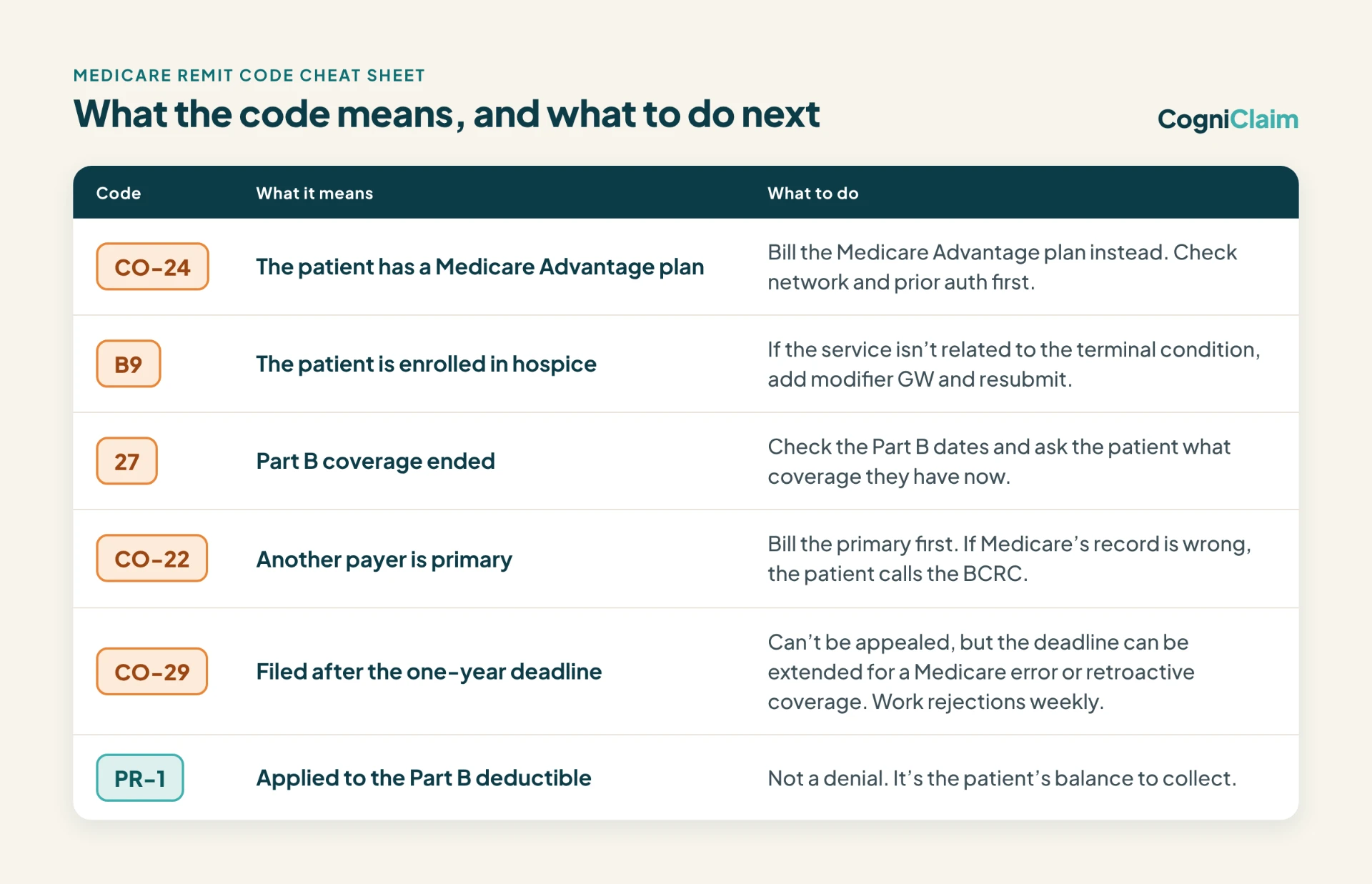
Medicare Advantage plans are run by private insurers like Humana, UnitedHealthcare and Aetna, and they take the place of Original Medicare. If the patient was enrolled in one on the date of service, Medicare generally won't pay the claim. Plenty of patients don't know the difference. They tell you "I have Medicare," hand you a card with an insurance company's logo on it, and the claim goes to the wrong place.
On your remit: CO-24, "Charges are covered under a capitation agreement/managed care plan."
How to fix it: Check eligibility for the date of service. If a Medicare Advantage plan was active, bill that plan instead. Before you do, confirm you're in its network and check whether it requires prior authorization, because these plans set their own rules. Going forward, verify coverage at each patient's first visit of the year. Medicare Advantage members can also switch plans, or go back to Original Medicare, between January 1 and March 31, so the coverage you verified in January may not be the same by spring.
2. The patient's Medicare information is wrong or out of date
Sometimes the Medicare details in your system are just wrong: a mistyped number, an old number, or a referral that came over with half the information missing. Every Medicare patient has an 11-character Medicare Beneficiary Identifier (MBI), and it can be replaced, usually because it was compromised, for example when a card is lost or stolen. When that happens, the old number stops working for new dates of service.
The rule is simple once you know it. For dates of service before the change, either the old or the new MBI works. For dates on or after the change, only the new one does. If an eligibility check suddenly comes back "Invalid MBI" for a patient you've seen for years, a replaced MBI is a likely reason.
One practice I bill for treats Medicare patients in assisted living facilities, and I run into this there all the time. Patients often get referred with incomplete or outdated Medicare information from the facility, and it's on us to track down the right details. The thing that saves us every time is making sure the provider gets the patient's Social Security number. With the patient's name, date of birth and SSN, I can look up their correct MBI in the online portal run by the Medicare contractor that processes claims for that region (for this practice, that's Wellpoint Federal, formerly NGS). The same portal also shows whether the patient has a Medicare Advantage plan and whether they've elected hospice.
Hospice is an easy one to miss. Once a patient elects hospice, Medicare Part B only pays for services that aren't related to their terminal condition, and the claim needs modifier GW to say so. Without it, the claim comes back denied with reason code B9 (patient enrolled in hospice). Services related to the terminal condition are the hospice's to cover, not Part B's.
How to fix it: Ask the patient for their current card, or look up their MBI in your Medicare contractor's online portal. You'll need the patient's name, date of birth and Social Security number, so collect the SSN at intake. Patients can also find it in their Medicare.gov account. Update it in your system before you resubmit, and while you're in the portal, check for a Medicare Advantage plan or a hospice election.
3. Part B coverage ended, or never started
Outpatient mental health care, including therapy and psychiatric visits, is covered under Medicare Part B. A patient can have Part A without Part B, and Part B can end, for example if the patient stops paying the premium. An eligibility check that just says "active Medicare" won't always show you that.
On your remit: reason code 27, "Expenses incurred after coverage terminated."
How to fix it: Look at the Part B start and end dates in the eligibility response, not just whether Medicare is active. If Part B ended, ask the patient what coverage they have now. Often it's a Medicare Advantage plan or an employer plan.
4. Medicare isn't the primary payer
Patients 65 and older who are still working, or whose spouse is, often have employer coverage that pays first. The general rule: if the employer has 20 or more employees, the employer plan is primary and Medicare is secondary. For patients who have Medicare because of a disability, the cutoff is 100 employees.
On your remit: CO-22, "This care may be covered by another payer per coordination of benefits."
How to fix it: Bill the primary plan first, then send the claim to Medicare with the primary's payment information. If Medicare's records are out of date (say, the patient retired and the employer coverage ended), the patient has to call Medicare's Benefits Coordination & Recovery Center at 1-855-798-2627 to update them. You can't do it for them. Once the record is fixed, resubmit. To head this off, have every Medicare patient fill out a Medicare Secondary Payer questionnaire at intake, and ask about other coverage again each year.
5. The clinician isn't enrolled, or the enrollment lapsed
Every clinician who bills Medicare for their own services has to be enrolled in Medicare under their own NPI. This one goes wrong in a few ways.
Seeing patients before enrollment. A clinician's Medicare enrollment generally takes effect on the date the application is filed, or the date they started seeing patients at that location, whichever is later. Medicare allows billing for services up to 30 days before that date, and no further back. If a new clinician sees Medicare patients for two months before anyone files their application, some of those sessions can't be billed. Get the application in before their first Medicare session.
A missed revalidation. Clinicians have to revalidate their enrollment roughly every five years. Miss the deadline and Medicare can deactivate the enrollment. Medicare doesn't pay for services furnished while an enrollment is deactivated, and when it's reactivated, the new effective date is the date the new application is received. Nothing fills the gap. You can check due dates in CMS's Medicare Revalidation List lookup tool.
A clinician Medicare doesn't recognize. Medicare pays psychiatrists and other physicians, nurse practitioners, physician assistants, clinical psychologists and clinical social workers. Since January 1, 2024, it also pays licensed marriage and family therapists and mental health counselors, including LPCs. To enroll, those clinicians need a state license plus at least two years or 3,000 hours of supervised clinical experience after their master's degree. That means a pre-licensed associate can't enroll or bill Medicare under their own NPI.
6. The claim was filed too late
Medicare's filing deadline is one calendar year from the date of service. Claims that arrive after that come back CO-29, "The time limit for filing has expired," usually with remark code N211, which means you can't appeal it. Medicare does extend the deadline in a few narrow cases, like a mistake by Medicare or coverage that was approved retroactively, but those are rare and not something to count on.
Late claims are usually claims that got stuck somewhere: rejected at the clearinghouse and never fixed, or sent to the wrong payer first (see #1). A rejected claim doesn't count as filed, so it doesn't stop the clock. The corrected claim still has to reach Medicare within the year.
How to avoid it: Work rejections every week, and look into any Medicare claim that's gone 30 days without a payment or a denial.
7. The telehealth details don't match
Medicare permanently covers mental health telehealth for patients at home. The claim still has to say where the patient was: place of service 10 when they were at home, and 02 when they were somewhere else. Audio-only sessions, which are allowed when the patient can't use video or doesn't want to, need modifier 93.
One date to mark: Medicare normally requires an in-person visit within six months before a patient's first telehealth mental health visit, and then once a year after that. That requirement is waived through December 31, 2027. If Congress doesn't extend it again, practices with telehealth-only Medicare patients will need a plan for in-person visits.
8. It wasn't denied. It went to the deductible.
Every January, some Medicare claims start paying $0, and it looks like something broke. Usually it's the Part B deductible. In 2026, patients pay the first $283 of covered Part B services before Medicare starts paying its share. CMS usually announces the next year's amount in mid-November and hasn't yet as of this writing. Medicare's trustees projected $292 for 2027.
On your remit: PR-1, the deductible amount. The "PR" means patient responsibility. It's not a denial, it's a balance to collect.
How to fix it: Check how much of the deductible a patient has left when you verify eligibility in January, and collect it at the visit instead of billing for it weeks later.
A short checklist before January

Most of these problems can be caught before the claim ever goes out. Here's what I'd do over the next few weeks:
- Verify every Medicare patient's coverage at their first visit of 2027: Original Medicare or Medicare Advantage, current MBI, Part B dates, any other insurance, and whether they've elected hospice.
- Have each Medicare patient update their Medicare Secondary Payer questionnaire.
- Look up every clinician's revalidation due date, and file applications for any new clinicians before their first Medicare session.
- Decide how your front desk will collect the Part B deductible in January.
- Pull every Medicare claim that's been unpaid for more than 30 days and find out why while there's still time to fix it.
If your Medicare claims keep coming back and you can't tell why, reach out through our contact form. Finding where claims get stuck is exactly what our free revenue audit is for.
For more billing tips and payer updates, follow CogniClaim on Facebook.
Sources
- Medicare Advantage Plan (CO-24), Noridian JF Part B
- Medicare Open Enrollment Guide, Justice in Aging
- Medicare Beneficiary Identifier changes, CGS Medicare
- Medicare Beneficiary Identifier (MBI), Noridian JF Part B
- Patient Enrolled in Hospice, Noridian JF Part B
- Tips to prevent CO-B9, First Coast Service Options
- NGSConnex MBI Lookup Tool, Michigan State Medical Society
- Frequently Asked Questions, Wellpoint Federal
- Tips to prevent CO-22 denials, First Coast Service Options
- Medicare Secondary Payer, CMS
- MSP Contractor (BCRC), Noridian JE Part B
- 42 CFR 424.520, effective date of billing privileges, Cornell Law School LII
- Revalidation, Noridian JF Part B
- Departmental Appeals Board decision CR7001 (deactivation and reactivation), HHS
- Marriage and Family Therapists and Mental Health Counselors, CMS
- Timely Filing, Noridian JF Part B
- 42 CFR 424.44, time limits for filing claims, eCFR
- Returned or rejected as unprocessable claims affect timely filing, First Coast Service Options
- Medicare payment policies, Telehealth.HHS.gov
- Billing and coding Medicare Fee-for-Service claims, Telehealth.HHS.gov
- Rising cost of Medicare premium and deductibles in 2026, Healthcare Finance News
- Medicare Part B premium 2027, AARP