If your Blue Cross payments for medication management visits have looked a little light since July, you're probably not imagining it.
Several Blue Cross Blue Shield plans changed how they review evaluation and management (E/M) claims this summer. Since then, behavioral health practices in at least three states have reported being paid for lower-level visits than the ones they billed. Here's what's going on, how to check whether it's affecting your practice, and what you can do about it.
What changed
On March 16, 2026, Blue Cross and Blue Shield plans in Illinois, Montana, Oklahoma and Texas posted similar notices to providers. For dates of service on or after July 1, if a commercial claim doesn't support the E/M level that was billed, the plan will pay it at the lower level it believes is supported.
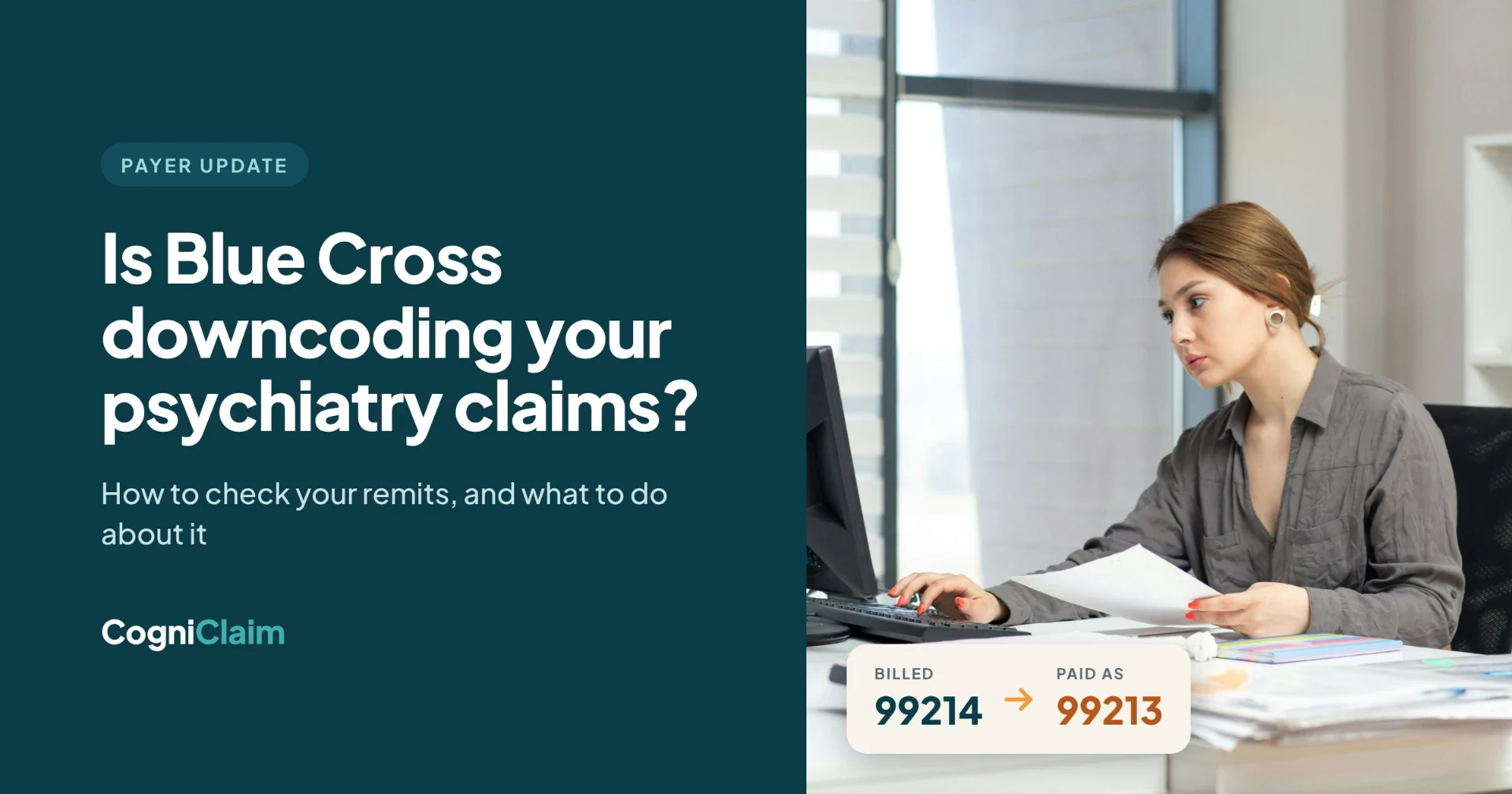
That's downcoding. You bill a 99214, and the plan pays you for a 99213.
The plans say they follow American Medical Association guidelines for level of service and medical decision-making. Providers who disagree with a reduction can send medical records to support the code they originally billed.
What practices are reporting
Providers in at least three states have spoken up so far.
- Montana: Psychiatric and addiction treatment providers told Behavioral Health Business that some downcoded claims were paying $60 to $110 less than before. One Helena practice said 17% of its adult claims and 39% of its pediatric claims were downcoded in July, and that the reduced claims kept landing on the same code: 99213. Providers filed complaints with the state insurance commissioner, whose office said it was engaging with Blue Cross.
- Illinois: The Chicago Sun-Times and WBEZ reported that one Chicago practice with psychiatrists and psychotherapists had about 2,400 claims reduced in July alone, and that providers said Blue Cross never asked for records first. The Illinois Psychiatric Society says at least 12 mental health organizations have contacted it about downcoding since July.
- Alabama: Behavioral health providers there have reported similar problems, according to a follow-up story from Behavioral Health Business in October.
What the plans say
To be fair to the other side: Blue Cross of Illinois and Blue Cross of Montana both say their review process doesn't automatically downcode claims or use AI to decide E/M levels. Blue Cross of Alabama says it doesn't automatically downcode either, and that it adjusts codes when a clinical review finds a claim was coded incorrectly.
Some reductions may well be legitimate. But when a practice that has billed the same way for years suddenly sees hundreds of claims cut without anyone asking to see a note, it's reasonable to question how those decisions are being made.
Who's most affected
This policy targets E/M codes, so the practices feeling it most are the ones that bill them: psychiatrists, psychiatric nurse practitioners, physician assistants and prescribing psychologists. That includes visits billed as an E/M code with a psychotherapy add-on, such as 90833.
If your practice only bills psychotherapy codes like 90834 and 90837, this particular policy isn't aimed at you. It's still worth paying attention, though. Payers have been watching 90837 closely for years, and downcoding practices have a way of spreading.
And if you're not in one of the states above, don't assume you're in the clear. The Alabama reports show this isn't limited to the four plans above.
How to tell if it's happening to you
Downcoding is easy to miss because the claim still gets paid. It just gets paid less. Here's how to check:
- Pull your Blue Cross remittances (ERAs or EOBs) for dates of service since July 1.
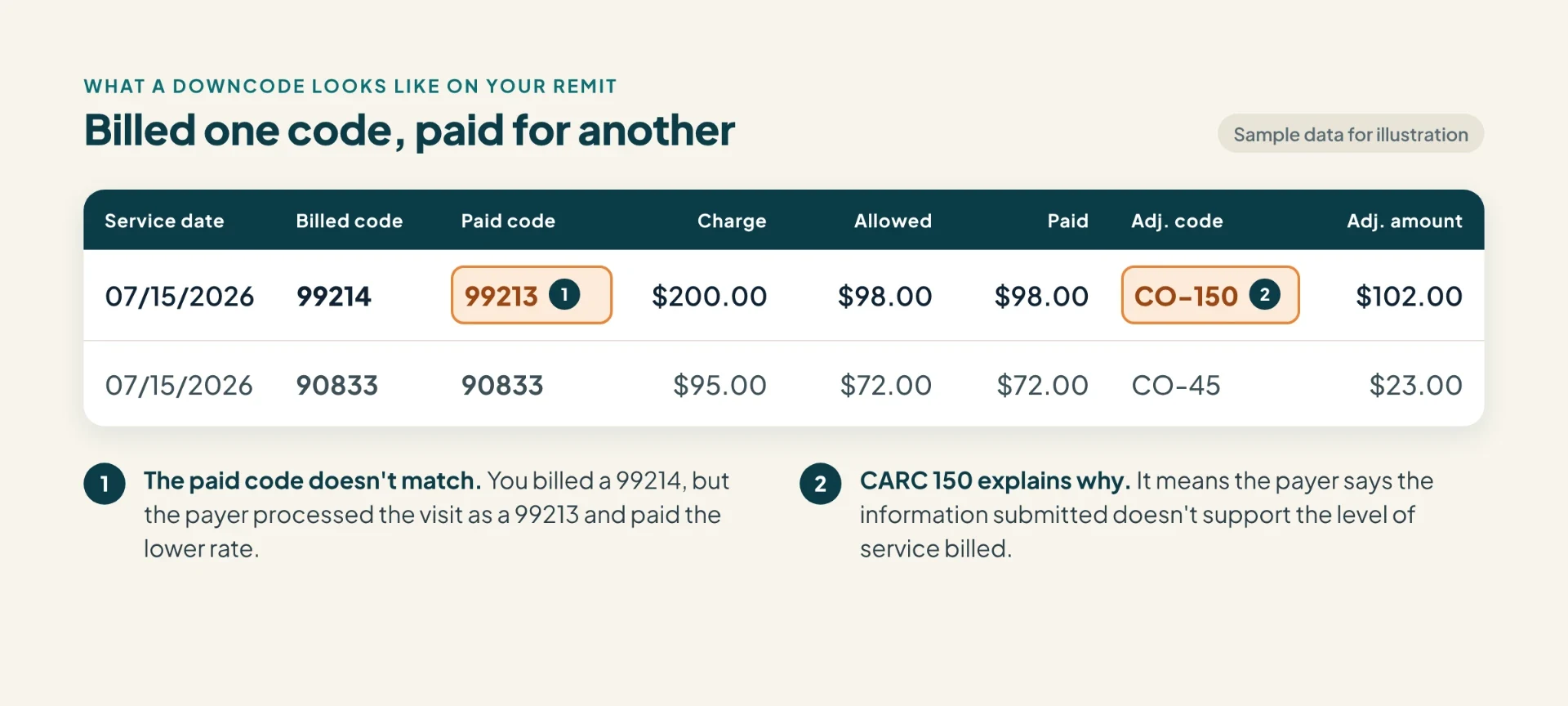
- Compare the code you billed to the code you were paid for. On a downcoded line, the paid code won't match what you sent. You'll often see an adjustment reason code like CARC 150, which means the payer says the information submitted doesn't support the level of service.
- Compare payments for the same code over time. If your 99214s used to pay one amount and are now paying at 99213 rates, that's your sign.
- Count it up. Note how many claims, which providers, which codes and the total dollars. You'll want those numbers for appeals and for any complaint you file.
What to do about it
Check your documentation first. The E/M level has to be supported by the note, based on either medical decision-making or total time. One common gap in psychiatry: when you bill an E/M code with a psychotherapy add-on, the time you spend on psychotherapy can't count toward the E/M level. The E/M has to stand on medical decision-making alone. If your notes don't spell that out clearly, it's worth tightening up regardless of what any payer is doing.
Appeal the claims you can support. Send the records that back up the code you billed. It's tedious, but it works more often than not. The Illinois Psychiatric Society's president told Behavioral Health Business that 70% to 80% of appeals are being paid, though some clinicians are spending four to five hours a week on them. A standard appeal letter and a simple tracking sheet will save you a lot of time.
Look for patterns. Is every reduced claim landing on the same code? Is it one provider, one visit type or one diagnosis? Write it down. Patterns carry weight in appeals, complaints and contract conversations.
File a complaint with your state's insurance department. Montana providers did exactly that, and their state associations backed them up. If your professional association is collecting reports, send yours in too.
Read your contract. Look for anything about claims review, coding adjustments and disputes. That's where your rights are spelled out.
Know your state's laws. Illinois recently passed the Transparency in Downcoding Act, which will ban downcoding based only on diagnosis codes and require a person, not just an algorithm, to make or review downcoding decisions. It doesn't take effect until January 1, 2028, though, and according to law firm Polsinelli it only protects physicians, physician assistants and advanced practice nurses, so some behavioral health professionals aren't covered. Georgia, Indiana, Virginia and Arkansas have passed similar laws, so check what applies where you practice.
The bigger picture
Downcoding hits small practices hardest. Each claim might only be $60 or $100 short, but that adds up quickly, and fighting it takes time most clinicians don't have. Several providers interviewed for these stories said they're thinking about leaving Blue Cross networks altogether, which would make it even harder for patients to find care.
This is exactly the kind of thing I look for when I review a practice's claims. If you'd like a second set of eyes on your Blue Cross remits, I'm happy to take a look. Request a free revenue audit.
Sources
- Blue Cross and Blue Shield of Illinois: Claim Editing Changes for Evaluation and Management Services (March 16, 2026)
- Blue Cross and Blue Shield of Montana: Claim Editing Changes for Evaluation and Management Services (March 16, 2026)
- Blue Cross and Blue Shield of Oklahoma: Claim Editing Changes for Evaluation and Management Services (March 16, 2026)
- Texas Medical Association: BCBSTX to Implement Downcoding Policy July 1
- Behavioral Health Business: Providers Fight Downcoding Efforts by BCBS Entity (August 28, 2026)
- Chicago Sun-Times and WBEZ: Blue Cross Blue Shield lowers payment for therapists, pediatricians under new 'downcoding' policy (August 26, 2026)
- Polsinelli: BCBSIL's New Downcoding Policy Raises Reimbursement Concerns Ahead of New Illinois Restrictions (September 21, 2026)
- Behavioral Health Business: BCBS Downcoding Issues Impact Behavioral Health Providers in Multiple States (October 7, 2026)
- Illinois General Assembly: Public Act 104-0568, Transparency in Downcoding Act
This article is for general information and isn't legal or coding advice. Payer policies change often, so check your payer's current guidelines before acting.